
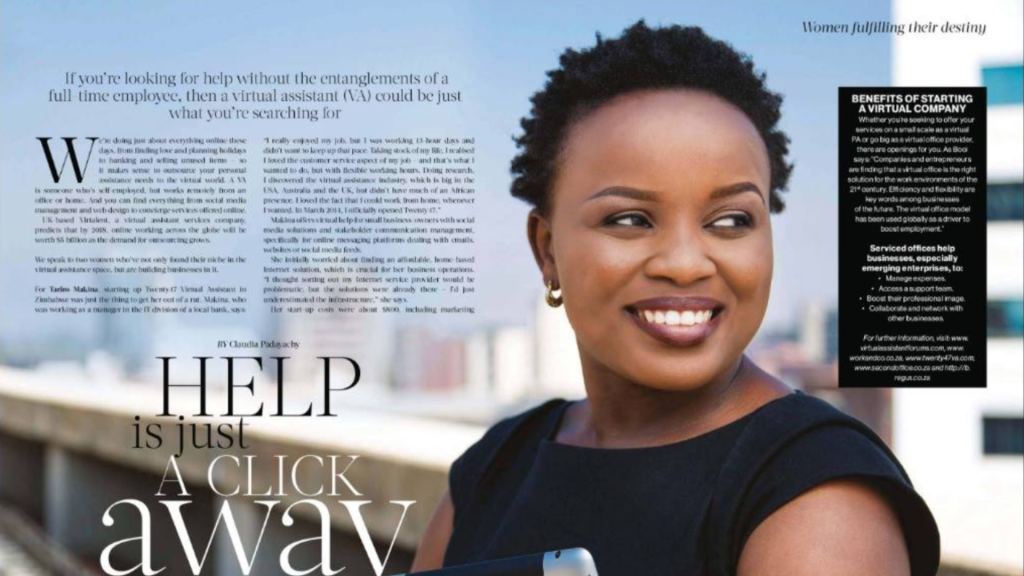
My conversations with aspiring remote professionals usually start out the same way: an anxious greeting, then a list of all their qualifications, then the most famous question in my DMs.
“Tariro, what can I do with this?”
I am sure a lot of them are surprised by my response, because I hardly ever talk about the qualifications they have just listed.
Why? Because in the global remote work space, this hardly matters. What matters far more is what you can actually do, and how you can add value to people’s businesses and lives. Having a particular qualification doesn’t automatically qualify you for a particular job. Proving you can do the work, with evidence of real delivery, does that job far better.
This usually gets people in a bind. “But Tariro, I want to do work around my degree.”
I understand. I am sure you have been made to believe that this is how life works. I used to think that too. So let me tell you a short story about my own journey.
How I Got Here
I started working when I was around 12 or 13 years old. The job was to do anything my dad told me to do in the family event equipment hire business. And I mean anything. Over the years I was a receptionist, a cleaner, a customer service representative, a personal assistant, an executive assistant, a gatewoman, an IT support technician and a bookkeeper. When duty called, I would even go and help set up tents, tables and chairs.
I did this for more than a decade, during school holidays and later during semester breaks at college. After college, having studied Computer Science, I landed my first “proper” job as a graduate trainee at a local bank. That became a career I eventually cut short, because starting an online business seemed like a good idea. A little over three years in, I walked away from that too and launched myself as a Virtual Assistant.
A lot of people wondered why I would make such a transition. I was in middle management at a bank and my career appeared to be on the rise. I can tell you why for free.
Being a Virtual Assistant let me use the skills I had gathered over the years in a far more creative way, and for a much wider audience. To be honest, I didn’t realise it at the time, but I wasn’t reaching for what I had learned as an IT Applications Manager. I was reaching all the way back to the skills I picked up sitting at the reception desk outside my father’s office, serving clients who were planning their events.
The Mistake That Cost Me Years
I had entered a space where nobody really cared that I had a Computer Science degree, or that I had worked through major banking system implementations, upgrades and integrations with some of the most influential financial platforms in the world. In fact, all of that confused people.
So I found myself in a very strange place. Deep down, I knew I had what it took to serve as a VA. But I struggled to position myself as one, because my mind was so fixated on the degree and on what I thought the degree had qualified me to do. The result? In my first few years in business I struggled to find clients, because people simply could not understand what I was, or what I could do for them.
A few years on, after learning from more seasoned Virtual Assistants, investing in coaching for myself, and quite simply trying again, I realised something. I had not been wrong to become a VA. I had been wrong about where I started the conversation.
Every time I led with my qualifications, I buried the most important piece of the puzzle: what I actually knew. My skills, and how they could help people. That was where I was supposed to start all along. That was my point of strength. That was the zone I needed to serve from.
“But Isn’t Computer Science What You Know?”
At this point you might be wondering: but Tariro, surely Computer Science and your years as an IT Applications Manager are what you know? Isn’t that exactly the thing you should be leading with?
My answer is both yes and no.
Yes, because that training is real and it shaped how I think. Computer Science gave me a way of seeing systems, breaking problems down, and being patient with things that don’t work on the first try. I genuinely use that every single day to this day, in every role I have found myself in.
But also no, because a degree is not the same as a skill. I can hold a Computer Science degree and not be able to write a single clean line of code, while someone who taught themselves code in their bedroom as a teenage hobby runs circles around me. The certificate proves I sat through a programme. It does not prove I can do the thing. Clients are not buying my programme. They are buying the thing. They are buying what you can do for them with the thing and how you can solve their problems with the thing.
And the deeper truth is this: the most valuable thing I “know” was never on my transcript. It was learned at that reception desk long before university. It is knowing how to make a stressed client feel calm. How to listen for what someone actually needs versus what they first asked for. How to give a client what they ask for by probing into their desired outcomes. How to keep a dozen moving parts organised when everyone around me is panicking. That is what I was really selling. The degree was just the loudest line on my CV but it honestly was not the most useful.
The Skills That Actually Travel
When I finally looked honestly at my odd collection of jobs, I stopped seeing a messy list and started seeing an inventory. Every role had quietly taught me something that travels into almost any remote engagement:
Communication
Years at reception and in customer service taught me to write and speak clearly, to manage expectations, and to make people feel heard. In remote work, where your client may never see your face, clear communication is the whole relationship.
Negotiation
Helping clients plan events on a budget, and later setting my own rates and scope, taught me how to hold my ground, protect my time, and find the option that works for both sides.
Empathy
Serving people on what was often one of the most stressful days of their lives taught me to read the human in front of me, and not just the task. Empathy is what turns a one-off gig into a client who keeps coming back.
Organisation and problem solving
Bookkeeping, logistics, IT support and all kinds of ops and admin all taught me to bring order to chaos and to fix things when they break. Ultimately, that is exactly what a client is hiring a remote professional to do.
These are all transferable skills. They don’t belong to one industry or one job title, which is precisely why they are so valuable. The technical tasks of your future role can be learned, often quickly. The way you make people feel, the trust you build, the calm you bring under pressure are harder to teach but far easier to sell.
So, Start With What You Know
If you are an aspiring remote professional staring at your qualifications and wondering what you can do with them, I want to gently turn the question around.
Don’t start with what you studied. Start with what you can do. Look back across everything you have ever done, paid or unpaid, formal or informal, and ask yourself: What problems have I solved for people? What did I make easier, calmer, faster or clearer? What do people already come to me for without thinking about it?
That list, not your certificate, is where you start building your offer. That is where your start packaging how you solve problems.
Your job is not to wait until you feel “qualified enough.” Your job is to take the skills you already have, point them at a real problem a client is facing, and show that you can solve it. That is how you land your first client, and it is exactly the thing I wish someone had told me years earlier.
Ready to Start?
Figuring out what you know, and learning to lead with it instead of hiding it behind a qualification, is honestly the hardest part. It took me years and a fair amount of coaching to see my own value clearly. I would love to help you get there much faster.
That is exactly why I am developing Ready2Remote, suite of learning products for my aspiring remote professionals. Together we will unpack your real skills, position you in a way that clients actually understand, and build the confidence to go out and land that first client, starting from your point of strength. If you are ready to stop asking “what can I do with this?” and start showing the world what you can do, let’s talk. Book a Ready2Remote one-on-one session with me and let’s start with what you know.